
The Role of Structure in Reducing Stress
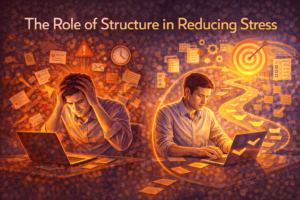
Stress is often treated as a personal problem—something to manage through resilience, mindset, or motivation. But in most professional environments, stress is not caused by weakness. It is caused by poorly designed work.
When work lacks structure, the mind stays in a constant state of alert. Decisions pile up. Priorities blur. Attention fragments. Stress becomes the natural response to uncertainty.
Structure reduces stress not by making people tougher—but by making work clearer.
Why Unstructured Work Feels Mentally Heavy
Stress increases when the brain is forced to make too many decisions too often. Each unanswered question creates cognitive load:
- What should I work on next?
- Is this urgent or important?
- When does this actually end?
- What happens if I stop?
When these questions are unanswered, the brain stays engaged even when work pauses. This is why unstructured work feels exhausting even without long hours.
Stress grows from ambiguity, not effort.
Structure Reduces Decision Fatigue
Structure removes repeated decision-making. It defines when, how, and what before stress can accumulate.
Examples of stress-reducing structure include:
- Clear work start and stop times
- Defined task scopes
- Known handoff points
- Consistent routines
By answering questions in advance, structure allows the brain to conserve energy. Less energy spent deciding means more energy available for thinking.
Why Stress Is Often a Design Problem
People often blame workload for stress, but volume is only part of the equation. Two people can have similar workloads—one feels calm, the other overwhelmed.
The difference is usually structure.
When work is fragmented, interruptions increase stress. When priorities shift constantly, anxiety follows. When expectations are unclear, pressure rises.
Structure stabilizes the environment. Stability lowers stress automatically.
The Link Between Structure and Psychological Safety
Structured work environments provide predictability. Predictability reduces anxiety.
When people know:
- What is expected
- When it is due
- How success is measured
- When work ends
Their nervous system relaxes. Stress decreases not because work disappears, but because uncertainty does.
Clarity creates psychological safety without extra effort.
Structure Prevents Overcommitment
Unstructured work encourages overcommitment. Without clear boundaries, tasks expand endlessly. Everything feels urgent. Saying “no” feels risky.
Structure introduces limits. It defines capacity. It makes trade-offs visible.
When capacity is clear, stress drops. People stop carrying invisible work in their heads.
Why Structure Is Not Rigidity
Structure is often misunderstood as control. In reality, good structure creates flexibility.
By stabilizing the basics, structure frees mental space for creativity and adaptation. When routines handle predictable work, attention becomes available for meaningful decisions.
Structure supports freedom by removing chaos.
Small Structural Changes That Reduce Stress Quickly
Stress reduction does not require large system overhauls. Small adjustments create immediate relief.
Examples:
- A daily “top three” priority limit
- Fixed times for deep work
- Clear task definitions before starting
- Explicit end-of-day shutdown routines
These changes reduce mental noise. Stress decreases because the brain stops tracking unfinished decisions.
Structure Protects Energy Over Time
Stress accumulates when recovery is ignored. Structure ensures recovery is built into work.
Clear stopping points prevent work from bleeding into rest. Predictable rhythms allow energy to replenish. Over time, this prevents chronic stress.
Without structure, recovery relies on willpower—and willpower eventually fails.
Why Structured Work Feels Calmer
Calm does not come from less responsibility. It comes from work that makes sense.
Structured work:
- Feels predictable
- Reduces surprises
- Limits unnecessary urgency
- Supports sustained focus
Stress declines not because people care less—but because they don’t have to compensate for poor design.
Designing Work That Reduces Stress
Reducing stress is not about doing less. It is about designing work better.
When structure is present:
- Decisions decrease
- Focus improves
- Energy stabilizes
- Stress becomes manageable
Stress is not a personal flaw.
It is often a signal that structure is missing.
Fix the structure—and stress follows
highly responsive