How Distraction Becomes the Default 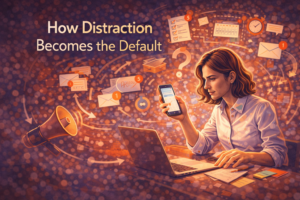
Distraction rarely arrives as a conscious choice. It creeps in quietly, shaped by habits, environments, and expectations that make divided attention feel normal. Over time, distraction stops feeling like a problem and starts feeling like the default way of working.
This shift happens without us noticing—and once it does, sustained focus begins to feel unusually difficult.
Why Distraction Feels Normal Today
Modern work environments reward responsiveness. Messages arrive instantly. Updates demand attention. Being available feels professional. As a result, attention is treated as a shared resource rather than something protected.
Each interruption feels minor. A quick reply here, a brief check there. But when interruptions are constant, the brain adapts. It learns to expect stimulation. Silence begins to feel uncomfortable.
Distraction doesn’t feel disruptive anymore—it feels familiar.
How Environments Train Attention
Attention is shaped by surroundings. Open tabs, alerts, background conversations, and open inboxes continuously signal that something else might need attention. Even when ignored, these signals create cognitive tension.
The brain stays partially alert, scanning for the next input. This state prevents deep focus from forming. Work becomes shallow not because people lack discipline, but because the environment discourages depth.
Distraction becomes the path of least resistance.
The Role of Habit in Default Distraction
Repeated behaviour becomes automatic. When people switch tasks frequently, the brain builds pathways that favour quick transitions over sustained attention.
Over time, focus weakens not through failure, but through training. The mind becomes efficient at switching and inefficient at staying. Concentration requires effort because it is no longer the practised mode.
Distraction becomes habitual—not intentional.
Why Multitasking Reinforces the Default
Multitasking accelerates the shift toward distraction. When multiple tasks are always active, attention never fully settles. Each task remains partially open, competing for mental space.
This constant partial attention creates mental fatigue. People feel busy but unfulfilled. Progress slows, yet activity increases.
Multitasking doesn’t just divide attention—it conditions the brain to avoid depth.
Digital Design and the Attention Economy
Many digital platforms are designed to capture attention, not preserve it. Notifications, badges, and infinite feeds exploit the brain’s sensitivity to novelty.
Because these systems are everywhere, distraction feels unavoidable. People blame themselves for a lack of focus rather than recognising the structural forces at play.
When attention is constantly pulled outward, internal focus weakens.
Why Focus Feels Harder Than It Used To
As distraction becomes the default, focus starts to feel unnatural. Sitting with a single task creates restlessness. The urge to check, switch, or scroll appears quickly.
This discomfort is often misinterpreted as an inability to focus. In reality, it reflects a nervous system accustomed to constant input.
Focus hasn’t disappeared—it has been displaced.
The Hidden Cost of Default Distraction
Default distraction carries a quiet cost. Thinking becomes reactive. Learning slows. Creativity narrows. Decisions rely more on habit than insight.
Over time, work loses meaning. Effort increases, but satisfaction declines. People feel mentally tired even after short work periods.
Distraction drains energy not by demanding effort, but by preventing restoration.
How Clarity Interrupts the Pattern
Clarity disrupts default distraction by giving attention a destination. When priorities are defined, distractions lose urgency. The brain knows what to return to.
Clarity reduces internal noise by closing open loops. It reduces external noise by defining boundaries. With fewer competing signals, focus has room to form again.
Focus returns not through force, but through alignment.
Reclaiming Attention in a Distracted World
Reversing default distraction requires intentional design. Attention must be protected, not left to chance.
Helpful steps include:
- Reducing unnecessary notifications
- Creating distraction-free work blocks
- Limiting open tasks
- Defining clear outcomes before starting work
These changes do not eliminate distraction, but they shift the default back toward focus.
Why Awareness Is the First Step
Distraction becomes powerful when it is invisible. Simply recognising how it has become the default changes the relationship with attention.
Focus is not about resisting distraction endlessly. It is about creating conditions where distraction no longer dominates.
Attention follows structure. When structure supports clarity, focus becomes natural again.