The Difference Between Thinking and Reacting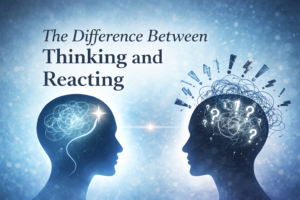
In modern work environments, speed is often rewarded. Messages demand immediate replies, problems expect instant solutions, and delays are interpreted as weakness. In this climate, reacting becomes the default mode of operation. Many people mistake this responsiveness for effective thinking. In reality, reacting and thinking are fundamentally different processes—and confusing the two quietly erodes judgment, focus, and long-term results.
Thinking creates direction. Reacting responds to pressure.
What Reacting Really Is
Reacting is a reflexive response to external stimuli. An email arrives, a notification appears, a problem surfaces—and the mind moves instantly to action. There is little pause, little evaluation, and little consideration of context. The goal is to remove discomfort quickly.
Reacting feels productive because it produces immediate movement. Something gets done. A message is answered. A task is cleared. But this speed often comes at the cost of quality. Decisions made in reaction are driven by urgency rather than importance.
Over time, constant reacting trains the brain to prioritize immediacy over judgment.
What Thinking Actually Involves
Thinking is a deliberate process. It requires pausing long enough to understand the situation, identify priorities, and consider consequences. Thinking does not rush to eliminate discomfort. It seeks clarity before action.
Good thinking asks questions such as:
- What actually matters here?
- What is the real problem?
- What outcome am I aiming for?
This process takes more effort initially, but it reduces mistakes, rework, and unnecessary stress. Thinking creates alignment between effort and purpose.
Why Reacting Feels Necessary
Reacting often feels unavoidable because modern work environments are built around interruption. Digital tools encourage immediate engagement. Expectations around availability reinforce the belief that speed equals competence.
There is also emotional pressure. Reacting provides a sense of control. It reduces anxiety temporarily by giving the mind something to do. Thinking, on the other hand, requires sitting with uncertainty long enough to understand it.
As a result, people react not because it is effective, but because it feels safer than slowing down.
The Hidden Cost of Constant Reacting
While reacting may resolve short-term issues, it creates long-term problems. When people operate in reactive mode, priorities are set by whoever interrupts them next. Important work is postponed in favor of urgent requests. Strategic thinking disappears under operational noise.
Cognitively, reacting increases mental load. Each interruption forces the brain to switch context. Focus fragments. Energy drains. By the end of the day, people feel exhausted without being able to explain what they actually accomplished.
Over time, this pattern leads to burnout, frustration, and declining decision quality.
How Thinking Improves Outcomes
Thinking changes the nature of action. When people think before responding, they choose their responses instead of being driven by them. Fewer decisions are made, but those decisions are better.
Clear thinking reduces unnecessary work. It prevents solving the wrong problem. It filters distractions and aligns effort with goals. Importantly, thinking does not eliminate responsiveness—it improves it by making responses intentional.
When thinking is prioritized, work feels calmer even when demands remain high.
The Role of Pause in Better Thinking
The difference between thinking and reacting often comes down to a pause. Even a brief pause allows the brain to shift from reflex to reflection. This pause creates space to assess relevance, urgency, and impact.
Pausing does not mean delaying indefinitely. It means resisting the urge to act immediately when clarity is lacking. Over time, this habit strengthens judgment and restores control over attention.
People who pause consistently appear composed, decisive, and confident—not because they work less, but because they think more effectively.
Choosing Thinking Over Reacting
Choosing thinking over reacting is a skill, not a personality trait. It requires setting boundaries around attention, reducing unnecessary interruptions, and defining priorities clearly.
When goals are explicit, reactions become fewer. When criteria are clear, decisions become easier. Thinking becomes the default, not the exception.
In a reactive world, the ability to think deliberately is a competitive advantage. Those who think before they act create better outcomes, experience less stress, and build work that lasts.
I am now totally aware of the difference and will become a thinking man for the fact that I would react based on prior experience. The thinking processed has allowed me not only to take stress off my mind but build on the thinking processed that allows the mind to control reactions. There will always be be an answer or solution to a problem but to react without thinking keeps our minds locked out of reality .
Not to mention all of the other wise decisions made just by thinking instead of reacting first.