Why Productivity Tools Don’t Fix Productivity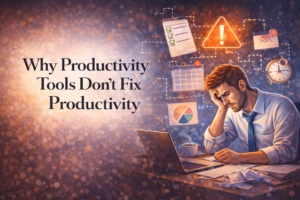
Every year, new productivity tools promise to make work easier. Smarter task managers, faster collaboration platforms, and sophisticated dashboards all claim to help people get more done. Many professionals adopt these tools with genuine hope that organization will finally bring control.
Yet despite better tools, productivity struggles persist. Work still feels overwhelming. Focus remains fragile. Progress feels inconsistent. This is not because the tools are bad. It is because tools alone do not fix productivity problems rooted in thinking.
Why Productivity Tools Are So Appealing
Productivity tools offer structure. They create order where work feels chaotic. Lists, calendars, and trackers provide visible control, which feels reassuring.
There is also the promise of efficiency. Tools suggest that if tasks are organized correctly, productivity will follow automatically. This idea is comforting because it shifts responsibility away from difficult decisions about priorities and focus.
Adopting a tool feels like taking action—even when the underlying problems remain unaddressed.
The Real Problem Tools Cannot Solve
Productivity problems rarely come from lack of organization. They come from unclear priorities, constant interruption, and competing demands. Tools can manage tasks, but they cannot decide what matters.
Without clarity, tools become containers for confusion. To-do lists grow longer. Notifications multiply. Dashboards display activity without meaning. People become efficient at tracking work rather than questioning its value.
When thinking is unclear, tools amplify noise instead of reducing it.
How Tools Can Increase Busyness
Ironically, productivity tools often increase workload. Each tool requires maintenance—updating lists, reviewing dashboards, responding to alerts. This creates additional tasks that feel productive but add little value.
The more tools people use, the more fragmented attention becomes. Switching between platforms interrupts focus. Context is lost. Real work is postponed while systems are managed.
In this way, tools can create the illusion of productivity while draining energy.
Why Tools Fail Without Clear Intent
Tools are most effective when they serve a clear purpose. When people know what they are optimizing for, tools can support execution. Without this intent, tools operate blindly.
For example, a task manager works well when priorities are defined. Without priorities, everything appears urgent. A calendar supports focus when time is protected. Without boundaries, it becomes a scheduling battlefield.
Tools follow thinking. They do not replace it.
The Difference Between Support and Substitution
Productivity tools are meant to support thinking, not substitute for it. Problems arise when tools are expected to compensate for unclear goals or poor decision-making.
When people rely on tools to create motivation, focus, or clarity, disappointment follows. Tools can remind, record, and organize—but they cannot decide, choose, or reflect.
Productivity improves when tools are used intentionally, not optimistically.
How Clarity Makes Tools Useful Again
Clarity transforms how tools function. When goals are clear, tools simplify work instead of complicating it. Lists become shorter. Schedules become realistic. Notifications become selective.
With clarity, people stop trying to manage everything. They manage what matters. Tools regain their original purpose: reducing cognitive load rather than increasing it.
In this context, tools enhance productivity because thinking leads and tools follow.
Choosing Fewer Tools, Used Better
Often, productivity improves not by adding tools, but by removing them. Fewer systems reduce friction. Familiar tools used consistently outperform complex systems used inconsistently.
Choosing one task manager, one calendar, and clear rules around their use creates stability. This simplicity supports focus and reduces decision fatigue.
Productivity thrives on restraint.
Why Better Thinking Beats Better Tools
At its core, productivity is a thinking problem. It depends on clarity, focus, and intentional decision-making. Tools can support these elements, but they cannot create them.
People who improve their thinking often find they need fewer tools. Their systems become simpler. Their work becomes calmer. Progress becomes more meaningful.
Productivity tools don’t fix productivity. Clear thinking does.