
How Poor Systems Create Burnout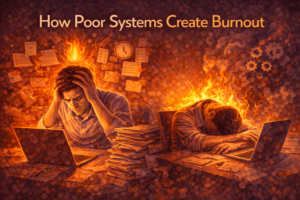
Burnout is often described as exhaustion, disengagement, or emotional fatigue. It is commonly treated as a personal problem—something to fix with rest, resilience, or motivation.
In reality, burnout is rarely caused by effort alone. It is usually the result of poorly designed work systems.
When systems fail, people compensate. And over time, compensation turns into burnout.
Burnout Is a Structural Issue, Not a Personal One
Most professionals don’t burn out because they dislike work. They burn out because work never stops demanding attention.
Poor systems force people to:
- Hold too much information in their heads
- Make repeated decisions unnecessarily
- Respond constantly instead of working deliberately
- Fill gaps left by unclear processes
The stress doesn’t come from working hard. It comes from working without structure.
How Poor Systems Increase Cognitive Load
Cognitive load refers to how much mental effort the brain must expend to function. Poor systems dramatically increase this load.
Examples include:
- Unclear priorities that require constant reassessment
- Vague task definitions that force repeated interpretation
- Frequent interruptions caused by lack of boundaries
- Inconsistent workflows that require constant adjustment
Each of these forces the brain to stay alert longer than necessary. Over time, this sustained mental strain leads to exhaustion.
Burnout begins long before energy runs out.
Why People Compensate for Broken Systems
When systems don’t work, people step in. They work longer hours. They stay mentally engaged after work. They become the system.
This compensation feels responsible at first. It creates short-term results. But it is unsustainable.
Instead of fixing structure, effort is increased. Instead of clarifying processes, people rely on memory and vigilance.
Eventually, compensation becomes the job—and burnout follows.
The Role of Unclear Boundaries
Poor systems rarely define clear stopping points. Work bleeds into evenings. Tasks linger mentally even when physically paused.
Without clear boundaries:
- Work feels endless
- Recovery feels incomplete
- Attention never fully disengages
Burnout thrives in environments where work has no defined edges.
Structure protects boundaries. Without it, exhaustion accumulates silently.
Why Busyness Masks Burnout Early
Burnout doesn’t always look like collapse. Early on, it looks like busyness.
People stay active. They respond quickly. They appear productive. But beneath the activity, mental fatigue grows.
Poor systems create constant urgency. Everything feels important. Nothing feels complete.
Busyness delays recognition of burnout—but doesn’t prevent it.
How Repetition Without Structure Accelerates Burnout
Repetitive work without structure is especially draining. When the same problems recur without improvement, frustration builds.
People burn out not from repetition—but from repeating inefficiency.
Well-designed systems reduce repetition by learning from experience. Poor systems force people to relive the same friction repeatedly.
Burnout is often the cost of stagnation disguised as effort.
Why Motivation Cannot Prevent Burnout
Motivation can delay burnout, but it cannot stop it. Motivated people often burn out faster because they push harder to overcome structural problems.
This creates a paradox: the most committed people suffer the most in poorly designed systems.
Burnout is not prevented by caring more.
It is prevented by designing better systems.
The Warning Signs of System-Induced Burnout
Burnout caused by poor systems often shows up as:
- Constant mental tiredness despite rest
- Difficulty focusing on meaningful work
- Irritability tied to small interruptions
- Feeling busy but ineffective
- Loss of satisfaction without loss of effort
These are signals—not of weakness—but of structural failure.
How Better Systems Reduce Burnout Naturally
When systems improve, burnout decreases without direct intervention.
Clear priorities reduce decision fatigue.
Defined workflows reduce mental tracking.
Boundaries restore recovery.
Consistency stabilizes energy.
People don’t need to “push through” when work makes sense.
Redesigning Work to Prevent Burnout
Preventing burnout starts with design, not endurance.
Key questions include:
- What decisions are repeated unnecessarily?
- Where is work unclear or undefined?
- What boundaries are missing?
- Where are people compensating for structure?
Fixing these issues reduces burnout at its source.
Burnout Is Feedback
Burnout is not failure. It is feedback from a system under strain.
Listen to it—not by demanding more effort, but by improving design.
When systems work, people don’t burn out.
They sustain.