
Why Burnout Is Not Caused by Hard Work Alone
Burnout is often blamed on hard work. Long hours. Heavy workloads. High expectations. The common advice is predictable: work less, rest more, slow down. 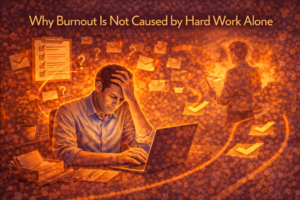
But this explanation is incomplete.
Many people work hard for years without burning out. Others burn out even when their workload doesn’t seem extreme. This tells us something important: burnout is not caused by hard work alone.
Burnout is usually the result of how work is designed, sustained, and supported over time.
Why Hard Work Alone Doesn’t Explain Burnout
Hard work can be tiring, but it isn’t always draining. People willingly invest effort in things they care about—building businesses, raising families, mastering skills—without feeling burned out.
The difference lies in sustainability.
Burnout emerges when effort is applied in conditions that continually drain energy without allowing recovery, clarity, or control.
Effort becomes harmful not because it is intense—but because it is unrelenting and poorly supported.
The Role of Chronic Cognitive Load
One of the biggest contributors to burnout is not physical effort, but mental strain.
When work requires constant:
- Decision-making
- Context switching
- Emotional regulation
- Unclear prioritization
the brain stays in a state of prolonged alertness. This sustained cognitive load exhausts attention and energy—even if working hours remain reasonable.
Burnout often begins in the mind long before it shows up in behavior.
Why Lack of Control Accelerates Burnout
Hard work feels very different when people have autonomy. Control over pace, priorities, and methods makes effort feel purposeful.
Burnout accelerates when people feel:
- Unable to influence workload
- Trapped in reactive cycles
- Constantly responding to others’ demands
- Unclear about what success looks like
Loss of control transforms effort into stress.
It’s not how much work you do—it’s how much agency you have while doing it.
The Cost of Unclear Expectations
Unclear expectations force people to guess constantly. They work harder to compensate for ambiguity.
Questions linger:
- Am I doing enough?
- Is this the right priority?
- When is this actually finished?
- What happens if I stop?
This uncertainty keeps the nervous system activated. Recovery never fully happens. Over time, exhaustion becomes chronic.
Burnout thrives in ambiguity.
Why Recognition and Progress Matter
Sustained effort requires feedback. When people can see progress, effort feels meaningful.
Burnout increases when:
- Progress is invisible
- Work feels repetitive without improvement
- Contributions go unnoticed
- Goals feel unreachable
Even manageable workloads become draining when effort feels disconnected from results.
Hard work without progress erodes motivation and energy.
The Hidden Impact of Poor Work Design
Burnout is often a design failure, not a personal one.
Poorly designed work includes:
- Constant interruptions
- Endless task lists
- No clear stopping points
- Work that spills into personal time
- Systems that rely on people to compensate
In these environments, people become the system. They carry the load mentally—and eventually, that load becomes too heavy.
Why Rest Alone Doesn’t Fix Burnout
Rest is essential, but it is not sufficient.
When people return from rest to the same conditions that caused exhaustion,
burnout reappears quickly. This leads to frustration and self-blame.
Recovery requires:
- Better boundaries
- Clearer systems
- Reduced decision fatigue
- Sustainable rhythms
Burnout resolves when the cause changes—not just when people pause.
Burnout as a Sustainability Signal
Burnout is not a weakness. It is feedback.
It signals that effort is being applied in a way that cannot be sustained under current conditions. Listening to this signal requires looking beyond hours worked—and toward structure, clarity, and support.
Burnout asks a different question:
How is work being designed—and at what cost?
Rethinking Burnout Prevention
Preventing burnout is not about lowering standards or avoiding effort. It is about creating conditions where effort can continue without constant depletion.
Sustainable work includes:
- Clear priorities
- Predictable rhythms
- Defined boundaries
- Autonomy over execution
- Visible progress
When these elements are present, hard work becomes energizing rather than exhausting.
The Real Conversation About Burnout
Burnout is not caused by caring too much or trying too hard.
It is caused by working hard in systems that drain more energy than they restore.
Fix the design, and effort becomes sustainable.
Ignore the design, and burnout eventually follows.