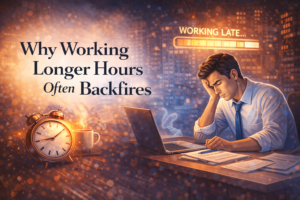
Why Working Longer Hours Often Backfires
When pressure increases, the most common response is to work longer hours. Stay late. Start earlier. Push through fatigue. In many cultures, long hours are treated as proof of commitment and ambition. They signal seriousness. They suggest dedication.
Yet time and again, working longer hours produces weaker results, not stronger ones. What looks like productivity on the surface often undermines performance beneath it.
Why Longer Hours Feel Like the Right Answer
Working longer hours feels logical. When there is more to do, adding time seems like the simplest solution. It avoids difficult trade-offs. It postpones the need to question priorities. It gives the comforting sense that effort will eventually solve the problem.
There is also social reinforcement. People who stay late are noticed. They appear reliable. Meanwhile, those who protect their time risk being misunderstood as disengaged.
This makes long hours an easy default—even when they are ineffective.
The Cognitive Cost of Extended Work
The brain does not operate at a constant level of quality. As hours accumulate, cognitive performance declines. Focus weakens. Decision-making slows. Errors increase.
Early in the day, thinking is sharper. Later, it becomes reactive. Tasks take longer. Simple problems feel complicated. The extra hours do not add proportional value—they dilute it.
This is why people often redo work completed late at night. Fatigue quietly erodes judgment.
Why Long Hours Reduce Decision Quality
Many important decisions are made when people are tired. This is where longer hours become dangerous. Fatigued thinking favors convenience over quality. People choose the easiest option, delay difficult decisions, or avoid thinking altogether.
Decision fatigue sets in when the brain has processed too many choices without rest. Long hours accelerate this process. As a result, more time is spent working, but less time is spent thinking well.
Poor decisions create more work later—undoing the benefit of those extra hours.
The Illusion of Dedication
Long hours often create the illusion of dedication without delivering results. Being present does not guarantee effectiveness. Sitting longer at a desk does not ensure progress.
In many cases, extended hours compensate for unclear priorities. Instead of deciding what truly matters, people attempt to do everything. This spreads effort thin and creates exhaustion without impact.
True dedication is not measured in hours, but in outcomes.
Why Recovery Is Essential for Productivity
Recovery is not a luxury; it is a requirement for sustained performance. Mental clarity depends on rest. Without it, the brain struggles to integrate information, recognize patterns, and generate insight.
Working longer hours reduces recovery time. Sleep suffers. Attention fragments. Motivation declines. Over time, this leads to burnout—a state where even normal workloads feel overwhelming.
Ironically, people who work the longest hours often produce the least creative and strategic work.
When Longer Hours Become a Habit
Once long hours become habitual, they stop being a temporary response and start defining how work is done. This normalizes exhaustion. People adjust expectations downward, accepting reduced focus as normal.
This environment discourages clarity. Instead of improving systems or priorities, organizations rely on endurance. The cost is paid in disengagement, turnover, and declining quality.
Sustainable productivity cannot be built on exhaustion.
What Works Better Than Longer Hours
Improving productivity rarely requires more time. It requires better thinking. Clear priorities, focused work blocks, and intentional rest often produce better outcomes in fewer hours.
Asking questions like:
- What work actually moves things forward?
- What can be postponed or removed?
- What decisions need clarity rather than more effort?
These questions reduce the need for long hours by improving alignment.
Why Clarity Outperforms Endurance
Clarity allows people to work with intensity when it matters and rest when it does not. This balance preserves energy and improves judgment. Over time, results improve—not because people work longer, but because they work better.
Working longer hours feels heroic. Working with clarity is effective. The difference shows in outcomes, not appearances.